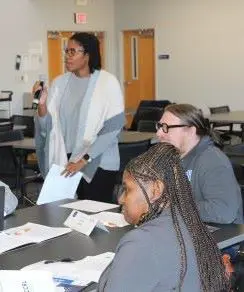
OCCRL welcomed educators, practitioners, and leaders from community colleges in Illinois to its Feb. 27 Equity Academy at Heartland Community College (HCC) for a day of reflection and renewed commitment.
Guided by an Indigenous framework, the theme (Guided by CARE: Looking Back to Look Forward) emphasized the wisdom needed to conduct authentic equity work already exists in relational, intergenerational, and community-centered ways of knowing. Rather than chasing new tools or initiatives, the gathering invited practitioners to reflect and ground their work in values such as relationship, responsibility, and care.
True to its tradition, the event in Normal brought together individuals who care deeply about students and are willing to ask hard questions about whether their institutions truly reflect that care.
The event began with warm welcome remarks from Ahja Howard, the director of the SUCCESS Program, who set the right tone by encouraging participants to “remember why we do this work.” Her speech was followed by talks from Dr. Keith Cornille, the president of HCC, and Dr. Terrance Bond, the assistant to the president for equity, diversity & inclusion at HCC. Their words were a reminder that this work is personal as much as it is professional.
Dr. Nicole S. Soulier then took the stage for the keynote address, and her topic could not have been timelier. As the director of college access and experience programs at Madison College in Wisconsin, Dr. Soulier knows how higher education continues to grapple with declining enrollment, growing student needs, and increasing pressure to demonstrate outcomes. The question of whether institutions are structurally built to support students or simply perform care when it is convenient has become one of the most pressing tensions practitioners face daily, according to Soulier.
With clarity and conviction, Soulier asked everyone in the room to sit with a question that is easy to avoid: Is the care we talk about built into our systems or does it only show up when it is convenient?
“Care is not sentimental; it is structural. Care is not rhetorical; it is operational,” she said.
Soulier then put forth a statement that many in the room could relate to: “Our system values efficiency… we say we value relationship, but we only value output.”
The observation is accurate, and most people in education have felt the weight of it at some point in their careers. For practitioners navigating the challenges of higher education spaces, Soulier's framing gave credence to a frustration many individuals carry but rarely have space to name. Her talk didn’t call anyone out; on the contrary, it called people in.
"Relationship cannot be episodic," she said.
Soulier’s message carried through during all following sessions, including the first one led by Dr. Osly Flores and Gabrielle Haggins, “Mapping Equity Goals Through Logic Models,” which provided attendees with a practical, accessible tool for turning equity values into action. This was a response to feedback from last year’s OCCRL post-survey results, where attendees advocated for an increased opportunity to move the logic model from theory to practice. Through interactive discussion and hands-on application, participants worked through how to connect institutional goals, strategies, and outcomes in a clear and trackable way that is aligned with the mission of serving diverse learners. It was exactly the kind of concrete next steps many attendees had been looking for.
The second session, “Race-Conscious Caring in Educational Leadership,” had a more personal feel. Dr. Flores was joined by Dr. Gianina Baker and used his recently published book, Race-Conscious Caring in Educational Leadership: A Narrative Ethics, to guide attendees through a reflective writing process rooted in their own stories. Participants explored how their personal identities and values shape the way they lead, and what it looks like to lead with both racial consciousness and genuine care. This session concluded with a case-study exercise that brought the concepts to life. One attendee noted that their “institution was navigating a similar situation, making the exercise helpful.” For many in the room, it was a reminder that this work is not happening in isolation.
Dr. Baker’s concluding remarks brought everything together, leaving the audience with the question Dr. Soulier had posed at the start: “We need to ask ourselves where the care is structural, where it is performative, which values are guiding you in this work, and in what ways those perspectives are expressed.”
The questions perfectly encapsulated why this work matters and is urgent.
View photos from the event.